0%
Reading Progress
Scroll to track your progress
When people hear the words root canal, they often imagine pain and discomfort. In reality, modern root canal treatment is a safe, effective, and relatively comfortable procedure that helps save your natural tooth and relieve pain — not cause it 😊
Let’s understand it clearly and simply.
What Is a Root Canal?
A root canal treatment (RCT) is a dental procedure used to treat infection inside the tooth.
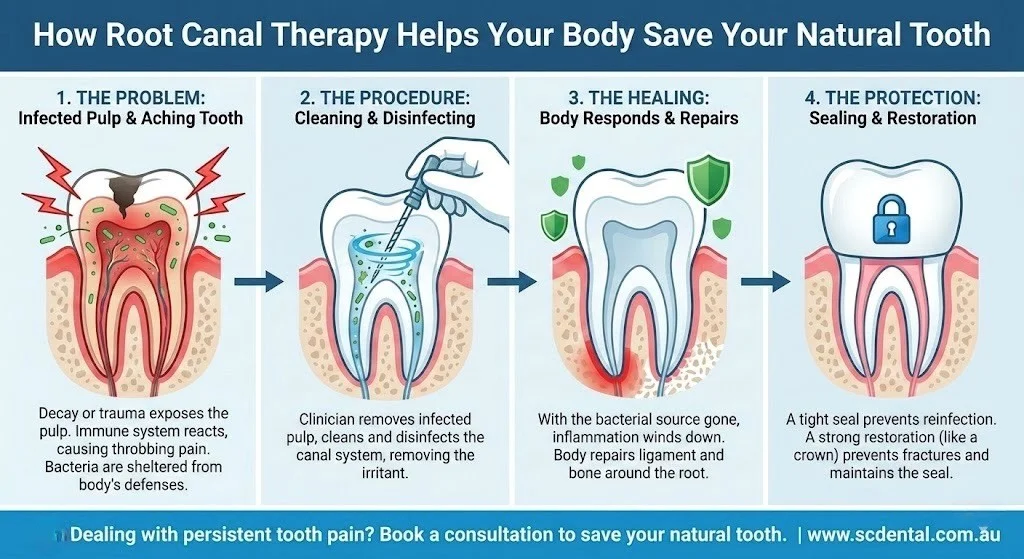
Inside every tooth, there is a soft tissue called the pulp, which contains nerves and blood vessels. When this pulp becomes infected due to:
Deep tooth decay
Cracked or fractured tooth
Repeated dental procedures
Trauma to the tooth
It can cause severe pain, swelling, and sometimes abscess formation.
Root canal treatment removes the infected pulp, cleans and disinfects the inside of the tooth, and seals it to prevent further infection.
Why Is Root Canal Treatment Needed?
You may need RCT if you experience:
Severe toothache, especially while chewing
Sensitivity to hot or cold that lingers
Swelling of gums
Tooth discoloration
Pimple-like swelling near the tooth (dental abscess)
Ignoring these symptoms can lead to spread of infection, bone loss, or even tooth loss.
How Is Root Canal Treatment Performed?
Here’s a step-by-step overview:
Diagnosis & X-ray – The dentist examines the tooth and takes an X-ray.
Local anesthesia – The area is numbed to ensure comfort.
Access opening – A small opening is made in the tooth.
Cleaning & shaping – Infected pulp is removed and canals are cleaned.
Disinfection – The canals are disinfected to eliminate bacteria.
Filling & sealing – The canals are filled with a special material (gutta-percha).
Crown placement – A crown is usually placed to strengthen and protect the tooth.
Modern techniques and anesthesia make the procedure almost as comfortable as a routine filling.
Is Root Canal Painful?
This is the most common question 😌
With modern dentistry and anesthesia, root canal treatment is usually not painful. In fact, it relieves the pain caused by infection.
You may experience mild soreness for a few days after the procedure, which is manageable with prescribed medications.
Benefits of Root Canal Treatment
Saves your natural tooth
Relieves pain and infection
Restores normal chewing function
Prevents spread of infection
Maintains natural smile and alignment
Saving your natural tooth is always better than extraction whenever possible.
What Happens If You Don’t Get Treatment?
If left untreated, the infection can:
Spread to surrounding tissues
Form an abscess
Cause bone loss
Lead to tooth loss
In rare cases, spread systemically
Early treatment prevents complications and reduces overall cost.
Aftercare Tips
After root canal treatment:
Avoid chewing on the treated tooth until crown placement
Maintain good oral hygiene
Brush twice daily and floss regularly
Visit your dentist for follow-up
A properly treated and restored tooth can last a lifetime with good care.
Final Thoughts
Root canal treatment is not something to fear. It is a conservative, tooth-saving procedure designed to eliminate pain and preserve your natural smile 😊